A recession does not equal a housing crisis. That's the one thing that every homeowner today needs to know. Everywhere you look, experts are warning we could be heading towards a recession, and if true, an economic slowdown doesn't mean homes will lose value.
The National Bureau of Economic Research (NBER) defines a recession this way:
"A recession is a significant decline in economic activity spread across the economy, normally visible in production, employment, and other indicators. A recession begins when the economy reaches a peak of economic activity and ends when the economy reaches its trough. Between trough and peak, the economy is in expansion."
To help show that home prices don't fall every time there's a recession, take a look at the historical data. There have been six recessions we have experienced over the past four decades. As the graph below shows, looking at the recession going all the way back to the 1980s, home prices appreciated four times and depreciated only two times. So, historically, there's proof that when the economy slows down, it doesn't mean home values will fall or depreciate.
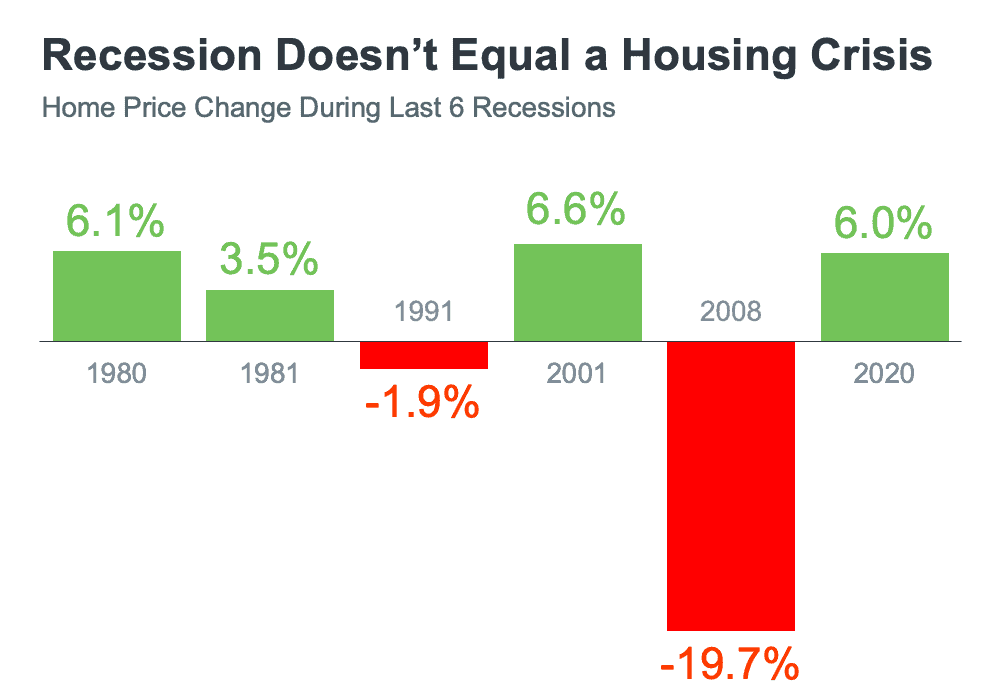
The first occasion on the graph when home values depreciated was in the early 1990s when home prices dropped by less than 2%. It happened again during the housing crisis in 2008 when home values declined by almost 20%. Most people vividly remember the housing crisis in 2008 and think if we were to fall into a recession we'd repeat what happened then. But this housing market isn't a bubble that's about to burst. The fundamentals are very different today than they were in 2008. So, we shouldn't assume we're heading down the same path.
The other big takeaway if a recession happens: interest rates usually go up at the beginning of an economic decline, but in order to stimulate the economy, they will typically fall.
According to Fortune:
"Over the past five recessions, mortgage rates have fallen an average of 1.8 percentage points from the peak seen during the recession to the trough. And in many cases, they continue to fall after the fact as it takes some time to turn things around even when the recession is technically over."
So, while the days of mortgage rates below 3% may be over, we also can't say for sure they're only going to go up from here. So, it's crucial to understand what to anticipate from today's shifting market.
What does this mean for you?
When we're constantly being bombarded with different opinions and information, it's easy to get lost in the noise. So, while signs of a market shift become clearer each day, it's important to remember that context is everything. Yes, we are seeing a slowdown. However, we are really just heading back toward the market pace we saw pre-pandemic, and those were still great years for real estate and homeowners.
Rising mortgage rates are no doubt one of the biggest factors impacting the housing market right now. But it's important to remember that the low-interest rates of the last few years were an anomaly.
Focus on the big picture, and that's this: the housing market is still very strong, and previous projections are already outperforming what industry experts forecasted earlier this year. Instead of getting caught up in headlines that do more to terrify than clarify what's really happening in real estate, cut through the noise and focus on what carries the most weight: expert-backed data and insights.
We're not in a recession, but if one is coming, it doesn't mean homes will lose value. History proves a recession doesn't equal a housing crisis. As inflation rises and mortgage rates climb, many may see their purchasing power shrink and their dream of homeownership fade.
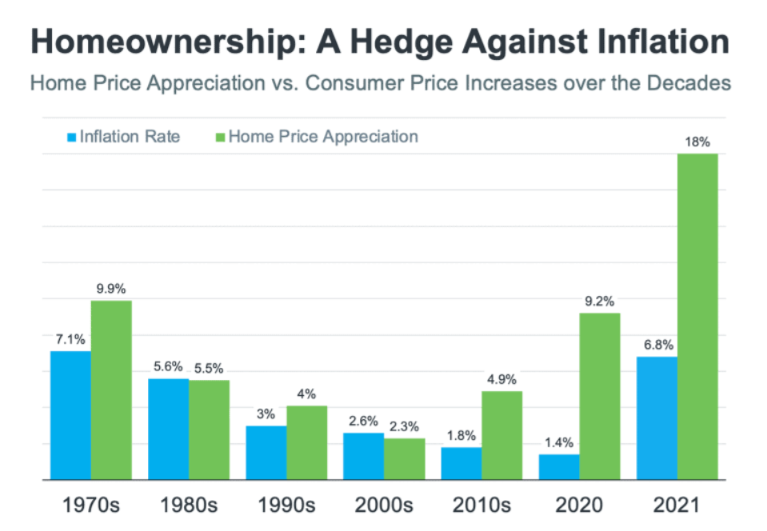
However, it's important to remember one big piece of economic wisdom: there is no better hedge against inflation than homeownership. Historically, we have seen homeownership outperform inflation in most decades. So, if there's an asset to invest in, housing is one of the few tangible assets that tends to hold its value.
source: KCM, CoreLogic, NBER, The Balance
Disclaimer: The above information is from sources believed reliable but should not be relied upon without verification. The publisher assumes no responsibility for its accuracy. You are encouraged to get independent legal advice before commencing any transaction.